

Inspire 2026
will feature a rich and diverse programme including keynote lectures, symposia, skills-based workshops and community-focused events.
The conference programme is currently under development and will be updated regularly. Below you find an overview of the planned structure.
INNOVATING CONNECTIONS: BRIDGING MIND, BODY and CULTURE THROUGH SCHEMA THERAPY
Keynotes & Plenary
Central sessions designed for all conference participants, including keynote addresses and award ceremonies.
Workshops & Training
Interactive, skills-based sessions I Clinical practice & professional training I Pre- and in-conference workshops
Science & Practice
Sessions presenting scientific research, clinical applications, and the integration of theory and practice.
Discussion & Exchange
Interactive, dialogue-oriented formats encouraging exchange, reflection, and discussion of emerging topics.
The INSPIRE 2026 in Thessaloniki Greece Programme
We are delighted to announce that the scientific programme for INSPIRE 2026, taking place in Thessaloniki, Greece (28–30 May), is now ready. The programme* reflects the vitality and diversity of contemporary Schema Therapy, bringing together outstanding international speakers, inspiring keynotes, high-quality workshops, clinically grounded case discussions, and innovative research contributions.
Under the theme “Innovating Connections: Bridging Mind, Body, and Culture through Schema Therapy,” the conference explores how Schema Therapy continues to evolve through cultural perspectives, somatic approaches, and the integration of current research. With over 180 abstract submissions, INSPIRE 2026 highlights the strong engagement and ongoing growth of the global schema therapy community.
For the first time in INSPIRE history, in-person participants can also experience a special Alternative Experience Track, offering live and interactive ways to explore the connection between body and mind. We warmly invite you to explore the programme and join us for what promises to be an inspiring and memorable conference.
 Download the Programme
Thursday Pre-conference I 28 May 2026
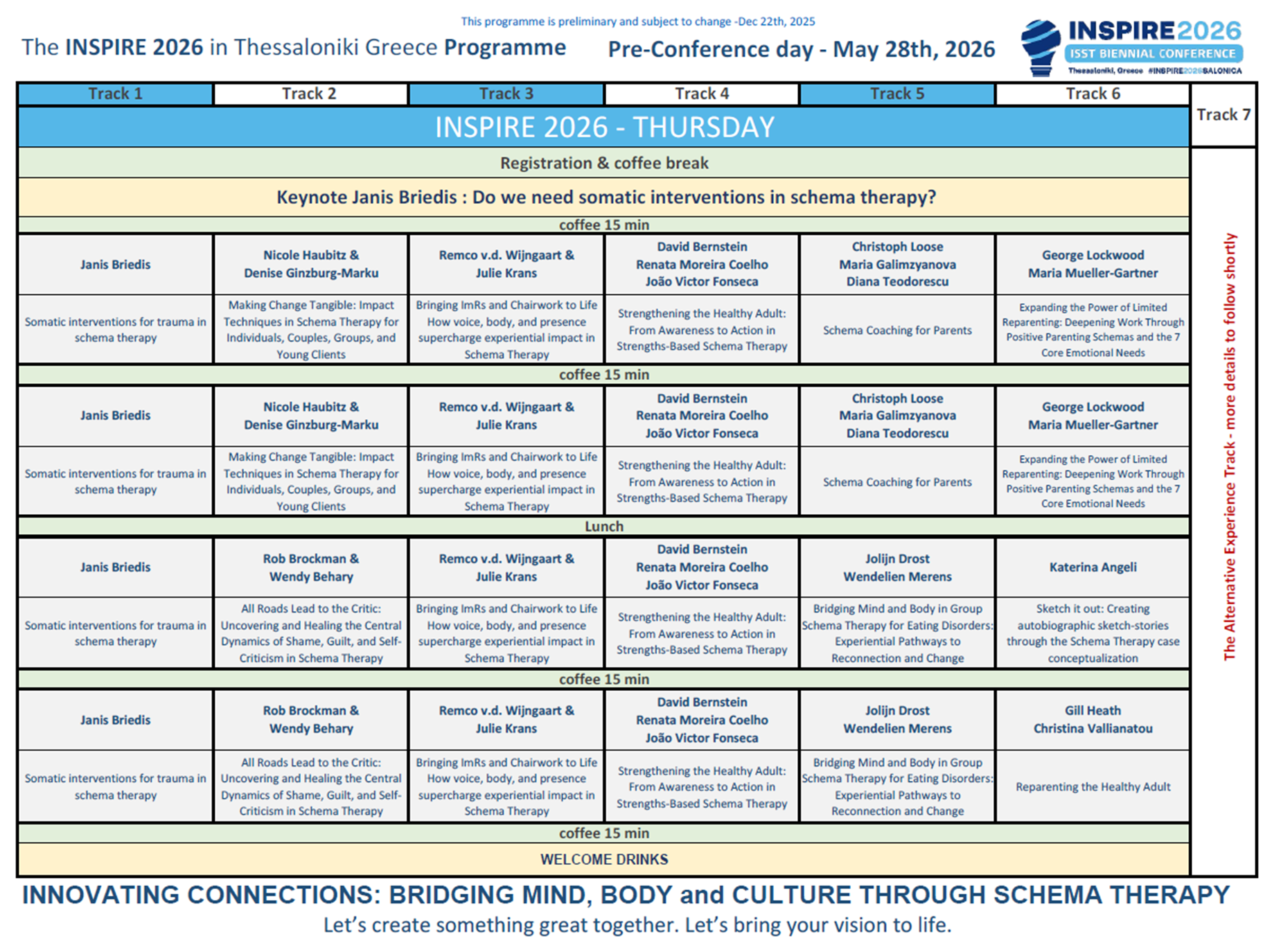 Friday conference I 29 May 2026
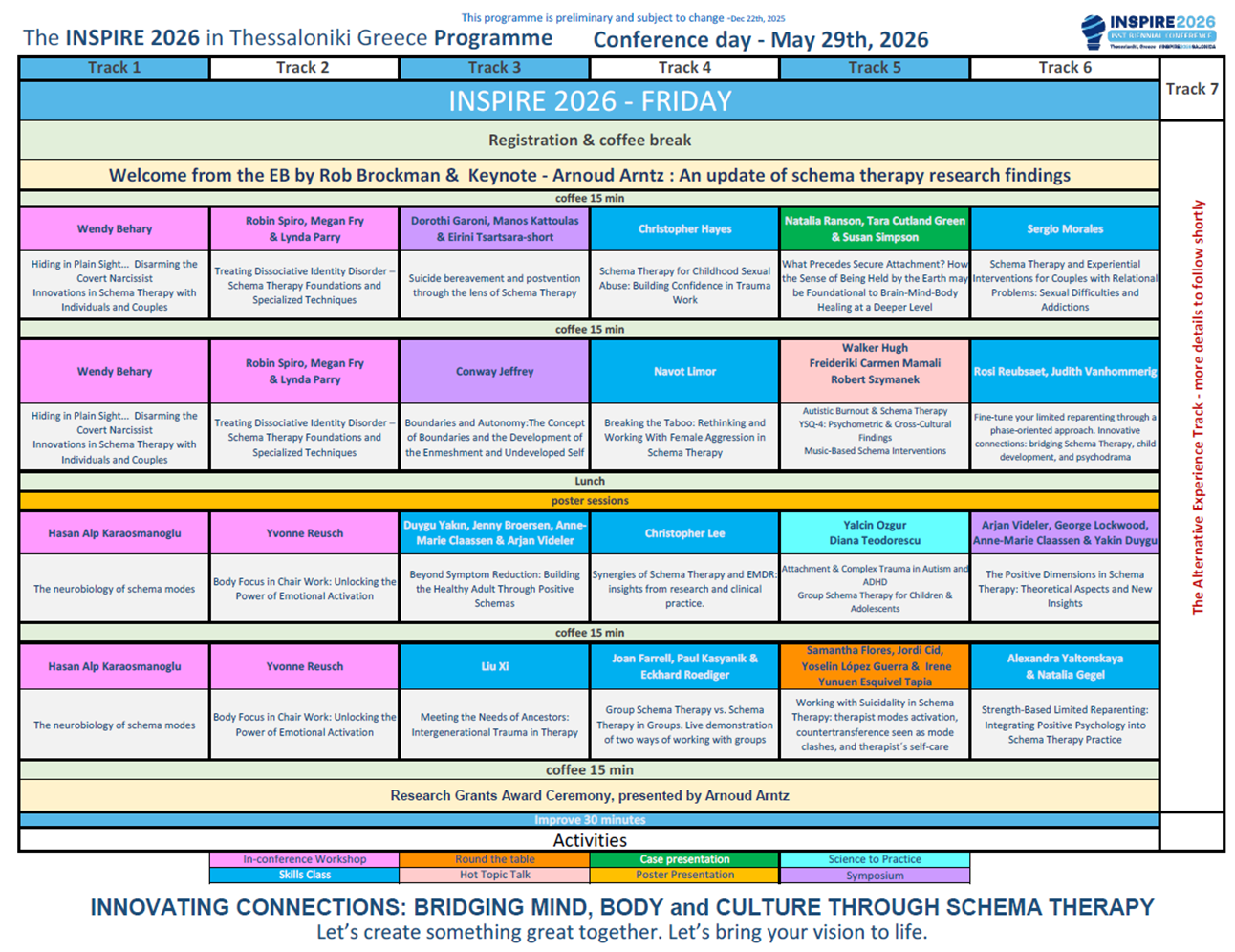
Saturday conference I 30 May 2026
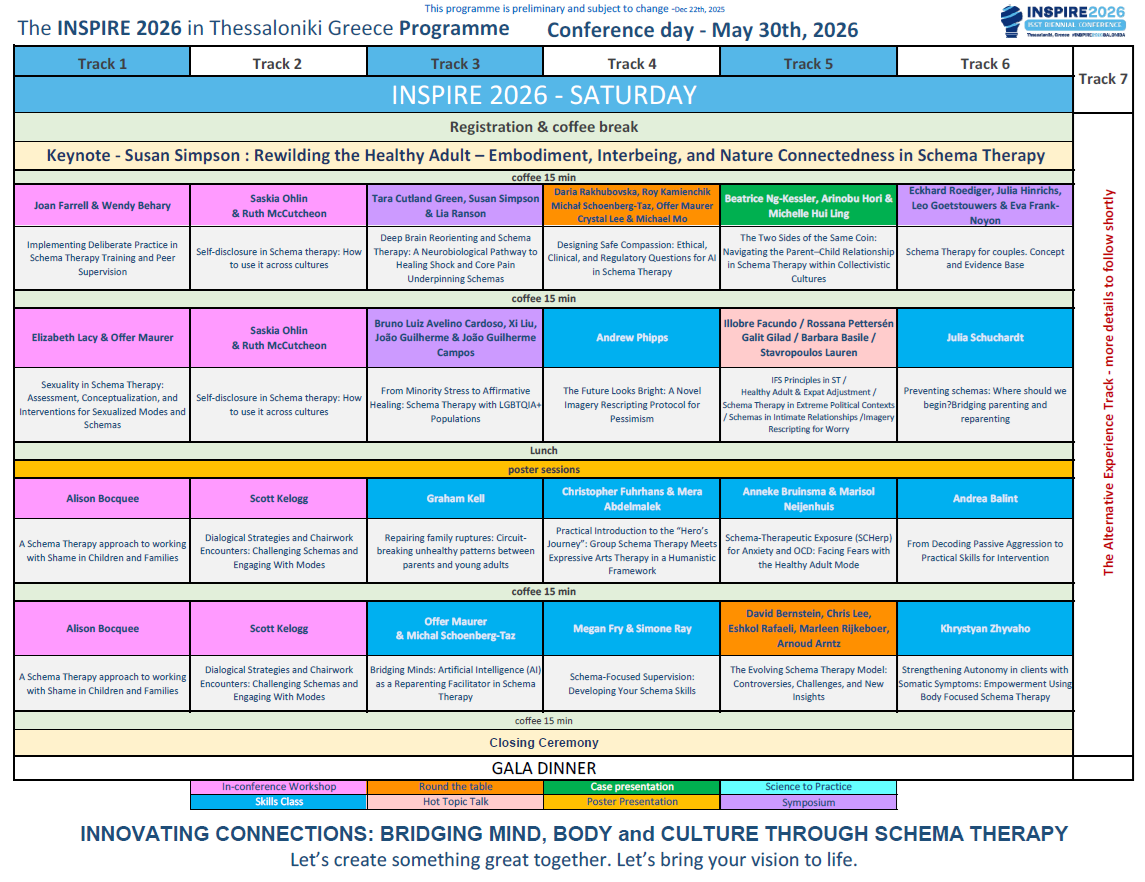
*This programme is preliminary and subject to change -Dec 22th, 2025
Keynotes & Plenary
Central sessions designed for all conference participants, including keynote addresses and award ceremonies.
Keynotes
Rewilding the Healthy Adult – Embodiment, Interbeing, and Nature Connectedness in Schema Therapy
Thursday 28TH, 2026
This keynote proposes a reconceptualisation of the Healthy Adult mode through embodiment, relationality, and nature connectedness. Integrating Schema Therapy with neuroscience, phenomenology, and Indigenous perspectives, it explores how reconnection with body, nature, and interbeing may address a foundational form of deprivation and support deeper psychological, cultural, and ecological healing.
Susan Simpson I Clinical Psychologist I ISST Supervisor Accreditation: Individual, Group
An update of schema therapy research findings
friday 29TH, 2026
This keynote presents an overview of the most recent large-scale research findings relevant to Schema Therapy, including randomized controlled trials comparing ST with other evidence-based treatments and new data on Imagery Rescripting. It also introduces first results from an international collaboration developing extended Schema Therapy assessment instruments, with implications for theory, measurement, and clinical decision-making.
Prof. Arnoud Arntz I Pprofessor emeritus of clinical psychology I ISST Honorary Member I Faculty of Social and Behavioural Sciences I Programme group Clinical Psychology
Research Grants Award Ceremony
Research Grants Award Ceremony, presented by Arnoud Arntz
friday 29TH, 2026
Workshops & Training
Interactive, skills-based sessions focusing on clinical practice, training, and professional development. Includes pre-conference and in-conference workshops of varying duration.
 Pre-Conference
Pre-Conference Workshops – ¼ Day
Sketch it out: Creating autobiographic sketch-stories through the Schema Therapy case conceptualization
Presenter: Katerina Angeli
This skills class explores the use of sketching and drawing as experiential, non-verbal techniques within Schema Therapy to access emotions, schemas, and modes that may be difficult to express verbally. Through clinical examples and guided experiential exercises, participants learn how visual arts can support embodied processing, deepen contact with the Vulnerable Child, and enrich case conceptualisation and therapeutic connection.
Reparenting the Healthy Adult
Presenter: Gill Heath I Christina Vallianatou
This workshop explores a relational approach to strengthening the Healthy Adult mode in clients who struggle to engage with purely strengths-based interventions. Drawing on research on emerging adulthood and clinical experience, the session outlines how the therapy relationship can meet Healthy Adult reparenting needs through scaffolded guidance, modelling, and supported agency to enhance adult functioning and resilience.
Pre-Conference Workshops – Half Day
Pre-Conference Workshops– Full Day
Somatic interventions for trauma in schema therapy
Presenter: Janis Briedis
This one-day experiential workshop introduces advanced somatic interventions within Schema Therapy for clients with complex trauma and attachment wounds. Grounded in neurobiology and attachment theory, it shows how trauma-related schemas and modes are often encoded and expressed through bodily sensations, symptoms, and non-verbal responses. Participants learn to safely track and work with these somatic signals using a structured 4-step model, titration, and co-regulation, while staying within the client’s Window of Tolerance. Through guided practices, case material, video examples, and experiential exercises, the workshop equips therapists to integrate body-based methods that strengthen a somatically grounded Healthy Adult mode, foster compassion toward the Vulnerable Child, and expand Schema Therapy with embodied pathways to healing.
Finetuning Imagery Rescripting: how to address different types of core emotional needs and antagonists?
Presenter: Remco v.d. Wijngaart I Julie Krans I Marjolein van Wijk-Herbrink
This experiential workshop focuses on Imagery Rescripting (ImRs) as a process of meeting unmet core emotional needs through corrective emotional experiences. Participants learn how to work with different types of antagonists—or their absence—within imagery, and how each configuration calls for addressing specific emotional needs beyond safety, such as attachment, autonomy, self-expression, spontaneity, realistic limits, and fairness. The workshop integrates a cross-cultural perspective, helping therapists adapt ImRs sensitively to cultural variations in how emotional needs are expressed and fulfilled, thereby bridging mind, body, and culture in rescripting work.
Strengthening the Healthy Adult: From Awareness to Action in Strengths-Based Schema Therapy
Presenter: David Bernstein I Renata Moreira Coelho I João Victor
This experiential workshop introduces Strengths-Based Schema Therapy (SBST), an integrative approach that combines Schema Therapy, Positive Psychology, Mindfulness, and Existential Psychology to rapidly strengthen the Healthy Adult mode and cultivate inner freedom. Participants learn how to identify stuck patterns, activate personal strengths to meet core emotional needs, and use evocative iModes imagery to make modes, needs, and strengths vivid and actionable. The workshop focuses on core SBST skills that can be integrated into any Schema Therapy practice, offering practical, evidence-informed tools for facilitating mindful choice, emotional flexibility, and strengths-based behavior change.
Conference
In-Conference Workshops
Hiding in Plain Sight… Disarming the Covert Narcissist Innovations in Schema Therapy with Individuals and Couples
Presenter: Wendy Behary
This workshop focuses on covert narcissism, a subtle and often overlooked presentation of narcissistic personality pathology marked by pseudo-vulnerability, passive aggression, victimhood, and emotional manipulation. Unlike overt narcissism, these patterns are easily misread as insecurity or genuine sensitivity, yet they often have deeply diminishing effects on partners and relationships. Using a Schema Therapy framework, the workshop helps clinicians accurately conceptualize covert narcissism, identify maladaptive coping modes, and address underlying unmet emotional needs rooted in early trauma, enmeshment, and attachment ruptures. Equal attention is given to treating partners, including schemas of self-sacrifice and subjugation. Participants learn practical strategies—such as mode work, imagery rescripting, inner-critic interventions, and behavioral pattern breaking—while strengthening their own Healthy Adult stance to work effectively with this complex and challenging population.
Sexuality in Schema Therapy: Assessment, Conceptualization, and Interventions for Sexualized Modes and Schemas
Presenter: Elizabeth Lacy I Offer Maurer
This workshop explores sexuality as a central expression of schemas, modes, and unmet emotional needs, addressing a topic that is common in clinical practice yet often avoided in schema therapy. It offers a clear framework for understanding and treating sexualized schemas, coping patterns, and modes with clinical sensitivity and depth. Participants learn to take attuned sexual histories, conceptualize how schemas (e.g. shame, deprivation, enmeshment) shape sexual experience, and apply adapted schema therapy interventions—including mode work, imagery, and chair techniques—to sexual themes. Special attention is given to LGBTQ+ clients, hypersexuality, infidelity, and cultural competence. The workshop combines theory, case examples, and experiential practice, supporting therapists in working confidently and compassionately with sexual material while managing their own schema activation.
Body Focus in Chair Work: Unlocking the Power of Emotional Activation
Presenter: Yvonne Reusch
This experiential workshop introduces a body-focused approach to chair work that enhances emotional activation by integrating posture, movement, and embodied expression into traditional dialogical techniques. Through live demonstration and guided practice, participants learn how attending to bodily processes can deepen emotional access and strengthen the therapeutic impact of chair work.
Self-disclosure in Schema therapy: How to use it across cultures
Presenter: Saskia Ohlin
This workshop explores how therapist self-disclosure can be used intentionally within Schema Therapy while remaining sensitive to cultural differences. Combining research, clinical examples, and experiential exercises, the session offers a culturally informed framework for using self-disclosure to strengthen therapeutic alliance, support limited reparenting, and model Healthy Adult functioning across diverse contexts.
The neurobiology of schema modes
Presenter: Hasan Alp Karaosmanoglu
This workshop introduces a neurobiologically informed, layered model of schema modes, integrating evolutionary, affective, and attachment-based systems. By conceptualising modes as sequential responses grounded in primary emotional and motivational systems, the session offers a coherent framework to enhance case formulation and refine interventions with core vulnerabilities and entrenched coping modes.
Implementing Deliberate Practice in Schema Therapy Training and Peer Supervision
Presenter: Joan Farrell I Wendy Behary
This workshop introduces the deliberate practice model as an effective approach for developing clinical competence in Schema Therapy. Participants learn how clearly defined micro-skills can be practiced in a structured way, supported by immediate, criteria-based feedback. Working mainly in triads (client, therapist, supervisor), the training focuses on challenging Schema Therapy micro-skills, including limited reparenting with overcompensating coping modes, the Angry Child mode, and working with the dysfunctional inner critic. The workshop demonstrates how deliberate practice strengthens traditional training and peer supervision formats, offering participants a practical, experience-based understanding of this innovative method and its benefits for skill development.
A Schema Therapy approach to working with Shame in Children and Families
Presenter: Alison Bocquee
This half-day workshop explores shame as an embodied, relational emotion rooted in early maladaptive schemas and transmitted through family and cultural patterns. Using a Schema Therapy framework, the session equips therapists with experiential, somatic, and relational interventions to transform shame-driven modes in children and caregivers into self-compassion, emotional safety, and connection.
Treating Dissociative Identity Disorder – Schema Therapy Foundations and Specialized Techniques
Presenter: Robin Spiro I Megan Fry I Lynda Parry
This workshop demonstrates how Schema Therapy provides a robust and compassionate framework for working with Dissociative Identity Disorder by engaging dissociative parts through attuned mode work and limited reparenting. Combining didactic input and live demonstrations, the session offers practical strategies to strengthen the Healthy Adult, promote cooperation among parts, and safely process traumatic memories through titrated interventions.
Dialogical Strategies and Chairwork Encounters: Challenging Schemas and Engaging With Modes
Presenter: Scott Kellogg
This experiential workshop presents a dialogical, chairwork-based approach to working with schemas and modes, reframing them as interpersonal voices such as Accusers and Advocates. Through demonstrations and practice, participants learn how evidentiary and cost–benefit dialogues can strengthen the Healthy Adult mode and support more self-directed, value-based living
Skills Class
Preventing schemas: Where should we begin?Bridging parenting and reparenting
Presenter: Julia Schuchardt
This skills class explores how schemas and maladaptive modes are transmitted across generations and how Schema Therapy can be used preventively to interrupt this process. Focusing on the Healthy Adult mode in both parenting and reparenting, the session introduces reflective and chair-based exercises to help caregivers and therapists foster healthier parent–child dynamics and support resilient emotional development.
Strength-Based Limited Reparenting: Integrating Positive Psychology into Schema Therapy Practice
Presenter: Alexandra Yaltonskaya I Natalia Gegel
This experiential workshop explores how integrating positive psychology and strengths-based principles can enhance limited reparenting within Schema Therapy. By focusing on resource activation and wellbeing alongside healing unmet needs, the session demonstrates how therapists can strengthen the Healthy Adult mode and foster growth through strength-based reparenting practices.
Schema Therapy and Experiential Interventions for Couples with Relational Problems: Sexual Difficulties and Addictions
Presenter: Sergio Morales I Aleksandra Defranc
This workshop explores how Schema Therapy can be applied to couples facing sexual difficulties and addiction-related challenges rooted in shame, disconnection, and unmet emotional needs. Using experiential techniques such as imagery rescripting, mode dialogues, and chair work, the session demonstrates how therapists can help partners transform dysfunctional modes, repair attachment ruptures, and restore emotional and sexual intimacy.
Repairing family ruptures: Circuit-breaking unhealthy patterns between parents and young adults
Presenter: Graham Kell
This skills class introduces the Prediction–Protection Circuit, a schema therapy tool for understanding and interrupting escalating parent–adolescent conflict. By mapping how parental and adolescent schemas and coping modes interact, the session equips clinicians with practical strategies to coach parents in applying schema-based “circuit breakers” that restore connection and reduce intergenerational patterns of conflict.
The many faces of shame in children – combining schema therapy with a cultural lens
Presenter: Alison Bocquee
This skills-based workshop examines shame in children as a schema-driven, embodied, and culturally mediated process that often presents through anger, withdrawal, compliance, or perfectionism. Using a Schema Therapy framework, the session equips therapists with culturally sensitive, mode-focused interventions to recognise shame, address intergenerational transmission, and foster emotional safety, resilience, and connection within families.
Schema Therapy for Childhood Sexual Abuse: Building Confidence in Trauma Work
Presenter: Christopher Hayes
This skills-based workshop examines shame in children as an embodied, schema-driven, and culturally mediated emotion that often appears through anger, withdrawal, compliance, or perfectionism. Using a Schema Therapy framework, the session equips therapists with culturally sensitive, mode-focused interventions to recognise shame, address intergenerational transmission, and foster emotional safety, resilience, and connection within families.
Group Schema Therapy vs. Schema Therapy in Groups. Live demonstration of two ways of working with groups
Presenter: Eckhard Roediger I Joan Farrell I Paul Kasyanik
This presentation compares two different ways of applying Schema Therapy in group settings. While Group Schema Therapy (GST) is an evidence-based protocol for borderline personality disorder, it is often difficult to implement in routine clinical settings and does not consistently outperform treatment as usual unless combined with individual therapy. In response, more flexible group-based approaches have been developed, particularly in German inpatient and day-treatment settings. These models focus on working intensively with one patient’s theme within the group, while other members contribute emotional resonance and Healthy Adult perspectives, drawing on core therapeutic factors of group therapy. Through a live demonstration, the workshop illustrates how Schema Therapy can be adapted to groups in multiple ways, highlighting practical alternatives that are easier to implement and allow more patients to benefit from schema-based interventions.
Schema-Focused Supervision: Developing Your Schema Skills
Presenter: Megan Fry I Simone Ray
This skills workshop supports developing schema supervisors in navigating supervisory relationships through a schema-informed lens. Focusing on supervisee core emotional needs and the supervisor’s roles as teacher, mentor, and limited reparenting agent, the session offers practical strategies to foster competence, autonomy, and reflective growth within a balanced supervisory alliance.
Synergies of Schema Therapy and EMDR: insights from research and clinical practice.
Presenter: Christopher Lee
This presentation explores the conceptual and clinical synergies between Schema Therapy and EMDR in assessing and reprocessing core developmental experiences underlying schemas and modes. Drawing on findings from the IREM trials, the session demonstrates how Imagery Rescripting and EMDR can be combined within and across sessions to enhance emotional processing and overcome treatment impasses in complex trauma.
Strengthening Autonomy in clients with Somatic Symptoms: Empowerment Using Body Focused Schema Therapy
Presenter: Khrystyna Zhyvaho
This presentation introduces a step-by-step Schema Therapy approach for working with complex somatic disorders by conceptualising physical symptoms as embodied expressions of unmet core emotional needs. Using clinical examples, the session demonstrates how body-focused, phase-specific interventions can strengthen autonomy and competence within the Healthy Adult mode and reduce persistent somatic distress.
From Decoding Passive Aggression to Practical Skills for Intervention
Presenter: Andrea Balint
This skills class examines passive-aggressive behaviour as a cross-cultural phenomenon rooted in unmet emotional needs, particularly the need for safe emotional expression. Using a Schema Therapy framework, the session explores relevant schemas, modes, and coping styles and equips participants with experiential and practical tools to recognise, conceptualise, and effectively address passive aggression in clinical practice.
Fine-tune your limited reparenting through a phase-oriented approach. Innovative connections: bridging Schema Therapy, child development, and psychodrama techniques
Presenter: Rosi Reubsaet I Judith Vanhommerig
This interactive workshop introduces a phase-oriented approach to Schema Therapy that structures treatment according to child developmental stages to guide therapist roles, interventions, and boundaries. By integrating developmental principles and experiential techniques, participants learn how to refine limited reparenting, meet core emotional needs more effectively, and support clients through clear, collaborative phases of therapeutic change.
Breaking the Taboo: Rethinking and Working With Female Aggression in Schema Therapy
Presenter: Limor Navot
This workshop explores how anger and aggression can manifest in subtle, culturally shaped ways in women and how these expressions may be overlooked or misidentified in Schema Therapy. By examining female presentations of aggressive modes through verbal, nonverbal, bodily, and neurobiological cues, the session helps therapists refine mode recognition, use their own reactions as diagnostic information, and apply attuned, mode-specific interventions to enhance safety and therapeutic movement.
Beyond Symptom Reduction: Building the Healthy Adult Through Positive Schemas
Presenter:Duygu Yakın I Jenny Broersen I Anne-Marie Claassen I Arjan Videler
This skills class focuses on moving beyond symptom reduction toward strengthening a resilient and well-functioning Healthy Adult mode. Research and clinical experience show that symptom improvement alone does not necessarily lead to lasting well-being, especially in more complex clinical populations. Participants will learn how to integrate positive schemas into chair work and imagery rescripting, using experiential techniques specifically designed to activate strengths, self-regulation, and healthy connection. The class demonstrates how these methods can be adapted for diverse populations, with attention to cultural sensitivity, neuro-affirmative practice, and developmental context. Through demonstrations, role plays, and guided practice, participants gain practical tools to help clients move from coping with difficulties toward cultivating a stronger, more resilient Healthy Adult.
Meeting the Needs of Ancestors: Intergenerational Trauma in Therapy
Presenter: Xi Liu
This workshop expands traditional Schema Therapy by exploring intergenerational trauma, moving beyond the child–caregiver dyad to include historical, cultural, and systemic legacies such as migration, war, persecution, colonisation, and poverty. These inherited experiences shape attachment, schemas, and core beliefs across generations. Through teaching, live demonstration, and guided role play, participants learn to identify inherited schemas and modes and apply an Intergenerational Trauma Script that extends imagery rescripting beyond two generations. The workshop integrates Schema Therapy with relational and trauma-informed approaches, emphasising cultural sensitivity, resilience, and healing across time. Participants gain practical tools to work with inherited trauma while supporting reconnection, meaning-making, and hope beyond survival.
The Future Looks Bright: A Novel Imagery Rescripting Protocol for Pessimism
Presenter:Andrew Phipps
This workshop introduces a novel imagery rescripting protocol designed to address dispositional pessimism, a pattern of persistent negative expectations about the future linked to poorer mental and physical health. Research suggests that pessimism is maintained by difficulties imagining vivid, positive future outcomes and by intrusive negative future imagery.Using the Schema Therapy imagery and mode framework, the workshop demonstrates how blocks, fear, and inhibition around positive future imagery can be understood and therapeutically addressed. Participants learn how vivid, detailed rescripting of positive future scenarios can strengthen motivation, optimism, and goal-directed behaviour. Through teaching, demonstrations, case examples, and role-play practice, participants gain practical skills to identify suitable clients and apply this imagery rescripting protocol effectively in clinical work.
Practical Introduction to the “Hero’s Journey”: Group Schema Therapy Meets Expressive Arts Therapy in a Humanistic Framework
Presenter: Christopher Fuhrhans I Mera Abdelmalek
This workshop offers a hands-on introduction to integrating the Hero’s Journey framework into Group Schema Therapy, enriched by methods from Expressive Arts Therapy within a humanistic perspective. Participants explore how symbolic storytelling, creative expression, and experiential group processes can support schema change, emotional processing, and meaning-making.Through guided exercises and practical demonstrations, the workshop shows how the Hero’s Journey can help clients externalise struggles, activate resources, and move toward growth and integration within a group setting. The approach is experiential, accessible, and easily adaptable to clinical and training contexts.
Schema-Therapeutic Exposure (SCHerp) for Anxiety and OCD: Facing Fears with the Healthy Adult Mode
Presenter: Anneke Bruinsma
This skills training introduces SCHerp, an integrative approach combining Schema Therapy with Exposure and Response Prevention (ERP) for anxiety disorders and OCD, particularly when standard ERP shows limited effect. The model addresses difficulties in inhibitory learning and personality-related blocks by actively engaging the Healthy Adult mode during exposure. Participants learn how to manage schema modes that arise during exposure, strengthen motivation, and support emotional learning. Through brief theory input, live demonstrations, and practical exercises, the training shows how schema-therapeutic techniques can help set meaningful exposure goals and improve adherence. SCHerp offers a practical, evidence-informed framework to enhance exposure-based treatments and support more sustainable change in complex anxiety and OCD cases.
Bridging Minds: Artificial Intelligence (AI) as a Reparenting Facilitator in Schema Therapy
Presenter: Offer Maurer I Michal Schoenberg-Taz
This workshop explores how AI can support limited reparenting in Schema Therapy by extending therapeutic support beyond sessions, without replacing the therapist or the therapeutic relationship.Participants learn how mode-specific AI tools can provide timely validation, soothing, and Healthy Adult support during everyday triggering situations. The workshop includes practical demonstrations and focuses strongly on ethical use, boundaries, and protecting the therapeutic alliance. The aim is to show how AI can act as a supportive bridge between sessions, helping clients internalise reparenting experiences and strengthen their own Healthy Adult mode.
Science & Practice
Sessions presenting scientific research, clinical applications, and the integration of theory and practice.
Symposia
The Positive Dimensions in Schema Therapy: Theoretical Aspects and New Insights
Presenter: Varjan Videler I George Lockwood I Anne-Marie Claassen I Yakin Duygu
This symposium presents recent theoretical developments and research findings on positive constructs in Schema Therapy, with a focus on positive schemas and the Healthy Adult mode. Contributions examine the relationships between core emotional needs, positive parenting and self schemas, and the Healthy Adult, highlighting areas of overlap, integration, and clinical relevance for strengthening adaptive functioning.
Deep Brain Reorienting and Schema Therapy: A Neurobiological Pathway to Healing Shock and Core Pain Underpinning Schemas
Presenter: Tara Cutland Green I Susan Simpson I Lia (Natalia) Ranson
This session introduces Deep Brain Reorienting (DBR) as a brain- and body-focused approach to healing core attachment trauma and the origins of schemas. Drawing on emerging neuroscientific evidence, the presenters demonstrate how DBR can complement Schema Therapy by addressing pre-affective shock and integrating somatic, relational, and neurobiological processes to support schema healing.
From Minority Stress to Affirmative Healing: Schema Therapy with LGBTQIA+ Populations
Presenter: Bruno Luiz Avelino Cardoso I Liu Xi I João Guilherme Campos I Jeff Conway
This symposium examines how Schema Therapy can be adapted to better address minority stress and sociocultural trauma in LGBTQIA+ clients. Introducing the Oppressive Sociocultural Mode and an Affirmative Healthy Adult mode, the session presents affirmative, strengths-based adaptations of core schema techniques aimed at reducing internalised stigma and fostering resilience, inclusion, and culturally responsive clinical practice.
Schema Therapy for couples. Concept and Evidence Base
Presenter: Eckhard Roediger I Julia Hinrichs I Leon Goetstouwers I Eva Frank-noyon
This symposium presents the conceptual framework and emerging evidence base for Schema Therapy for Couples, highlighting findings from pilot and multiple baseline studies demonstrating its effectiveness. The presenters outline a module-based approach and discuss how combining individual and conjoint sessions can enhance relational connection and clinical outcomes, particularly for couples affected by personality disorders.
Suicide bereavement and postvention through the lens of Schema Therapy
Presenter: Dorothy Garoni I Manos Kattoulas I Elena Rapti I Eirini Tsartsara
This symposium explores suicide bereavement and postvention through the lens of Schema Therapy, addressing the impact of suicide on relatives, communities, and therapists themselves. Through literature review, group interventions, and clinical case examples, the presenters illustrate how schema-informed approaches can support meaning-making, resilience, and healing while reducing stigma and fostering healthy professional and personal adaptation after loss.
Presenter: Jeffrey Conway
This presentation examines how healthy and unhealthy relational boundaries influence the development of autonomy and the emergence of the enmeshment and undeveloped self schema. Focusing on early development and the therapeutic relationship, it highlights how clear, respectful boundaries within limited reparenting can reduce schema perpetuating modes and strengthen autonomy-supportive functioning.
Science to Practice
Group Schema therapy for children and adolescents: A protocol that takes an innovative approach to Wise and Competent Mode development
Presenter: Diana Teodorescu I Anca Padurariu
This presentation introduces and evaluates a novel group Schema Therapy protocol for children aged 10–12, designed to strengthen the Wise and Competent Mode through structured skill development. Results from a controlled pilot study indicate significant reductions in anxiety, improvements in emotional intelligence, and shifts toward more adaptive coping strategies, supporting the protocol’s value for both prevention and early intervention.
Attachment, and Complex Trauma in Autistic and ADHD Individuals: Implications for Schema Development and Treatment
Presenter: Yalcin Ozgur (Oz)
This presentation examines how attachment disruptions, complex trauma, and systemic ableism shape schema development in Autistic and ADHD individuals. Using a neurodiversity-affirming lens, the session outlines adapted schema therapy approaches that address distinctive schema and mode patterns while promoting identity affirmation, sensory sensitivity, and inclusive clinical practice.
Case Presentation
The Two Sides of the Same Coin: Navigating the Parent–Child Relationship in Schema Therapy within Collectivistic Cultures
Presenter: Beatrice Ng-Kessler I Arinobu Hori I Hui Ling Michelle Neo
This case-based session examines how Schema Therapy interventions can lead to relational ruptures when applied without sufficient cultural adaptation in collectivistic contexts. Drawing on examples from Hong Kong, Singapore, and Japan, the presenters explore tensions between filial piety and autonomy and illustrate culturally sensitive strategies to adapt schema-focused work while preserving relational harmony.
What Precedes Secure Attachment? How the Sense of Being Held by the Earth may be Foundational to Brain-Mind-Body Healing at a Deeper Level
Presenter: Natalia RansonI I Tara Cutland Green I Susan Simpson
This presentation explores a pre-verbal dimension of core wounding that may precede attachment-based schemas, focusing on disruptions in gravitational security and the embodied sense of being “held.” Integrating insights from neuroscience, trauma therapy, and Deep Brain Reorienting, the session illustrates how brainstem-focused interventions can address shock and foundational trauma that lie beyond the reach of narrative and imagery-based techniques.
Poster Presentation
coming soon!
Discussion & Exchange
Interactive and dialogue-oriented formats that encourage exchange, reflection, and discussion of current and emerging topics.
Round Table Discussion
Working with Suicidality in Schema Therapy: therapist modes activation, countertransference seen as mode clashes, and therapist´s self-care
Presenter: Samantha Flores I jordi Cid I Yoselin Lopez I Irene Yunen Esquivel Tapia
This roundtable explores how therapists’ own schemas and modes may be activated when working with suicidal patients and how these interactions shape countertransference, empathy, and clinical decision-making. Emphasising supervision, self-reflection, and self-care, the session focuses on fostering the Healthy Adult mode in both therapist and patient to support ethical, sustainable, and resilient Schema Therapy practice.
The Evolving Schema Therapy Model: Controversies, Challenges, and New Insights
Presenter: David Bernstein I Chris Lee I Eshkol Rafaeli I Marleen Rijkeboer I Arnoud Arntz
This invited symposium brings together leading Schema Therapy theorists and researchers— Arnoud Arntz, Marleen Rijkeboer, Chris Lee, Eshkol Rafaeli and David Bernstein—for a roundtable discussion on key debates within the Schema Therapy model. The panel examines foundational questions about schemas, modes, basic emotional needs, and healthy functioning, including the roles of the Healthy Adult and Happy/Playful Child. Drawing on theory, research, and clinical experience, the discussion explores how the ST model can evolve while preserving its conceptual clarity, clinical usefulness, and teachability. Audience participation is encouraged, continuing Schema Therapy’s tradition of open, evidence-informed dialogue and critical reflection on its core concepts.
Designing Safe Compassion: Ethical, Clinical, and Regulatory Questions for AI in Schema Therapy
Presenter: Daria Rahubovska I Roy Kamienchik I Michał Schoenberg-Taz I Offer Maurer I Crystal Lee I Michael Mo
This round table initiates an ISST-wide discussion on the ethical, clinical, and regulatory implications of integrating AI into Schema Therapy. Drawing on emerging evidence and WHO guidance, the session explores risks, boundaries, and potential supportive uses of AI while safeguarding emotional safety, therapeutic integrity, and core schema therapy values.
Hot Topic Talk
A Schema Therapy approach to the treatment of recurrent cycles of Autistic Burnout: Recovery and rebuilding.
Presenter: Hugh Walker
This presentation conceptualises recurrent autistic burnout through a schema mode lens, highlighting how critic-driven coping patterns and internalised neurotypical norms perpetuate cycles of exhaustion and collapse. Drawing on clinical case material and a pilot group program, the session introduces a neurodiversity-affirming Schema Therapy approach aimed at strengthening a Healthy Neurodivergent Adult mode through compassion, sensory regulation, and group-based corrective experiences.
Advancing the Schema Therapy Model: Preliminary findings on the psychometric and cross-cultural validity of the Young Schema Questionnaire-4
Presenter: Freideriki Carmen Mamali
This presentation introduces the revised Young Schema Questionnaire (YSQ-4), developed by an international consortium to align schema assessment with an updated theoretical model of Schema Therapy. Preliminary cross-cultural findings on reliability and validity are presented, highlighting new schema constructs and refinements that strengthen the scientific and global foundations of Schema Therapy.
Harnessing the Power of Music: Interventions for Schema Awareness and Transformation
Presenter: Robert Szymanek
This presentation demonstrates how music can be used as an experiential medium to enhance schema awareness, meet core emotional needs, and strengthen healthy modes. Through live musical examples and reflective exercises, it introduces practical, adaptable interventions and outlines a conceptual framework for applying Schema principles within coaching and non-clinical contexts.
Slow Is Fast? Integrating IFS Principles into Schema Mode Work
Presenter: Facundo Illobre This presentation explores points of convergence between Schema Therapy and Internal Family Systems, with a focus on refining work with maladaptive coping modes. Drawing on IFS principles of pacing and sustained engagement with protector modes, the session proposes complementary strategies to enhance therapeutic attunement and effectiveness in complex and resistant clinical presentations.
“Home Is What You Carry: Strengthening the Healthy Adult to Cultivate Portable Belonging in Expatriates”
Presenter: Rossana Pettersén
This presentation introduces a Schema Therapy–informed intervention designed to address expatriate-specific schema and mode activation related to disconnection and belonging. Drawing on qualitative clinical data, the session presents a targeted module aimed at strengthening the Healthy Adult mode to cultivate a stable sense of “portable belonging” and emotional continuity across changing cultural contexts.
Let’s bring your vision to life.